


AI is powerful enough that teams now ask “How can we add AI?” before asking whether the user's problem actually involves uncertainty. That is backwards.
Use AI when uncertainty is part of the problem. Use normal software when the answer should simply be correct.
Start with the job, not the model
Describe what the user needs without using the word AI. Summarise a long document. Classify messy messages. Search across documents nobody has organised. Draft a reply. Extract fields from inconsistent files.
If the job can be written as deterministic rules — fixed logic that gives the same answer every time — or as a normal database query, start there.
AI is strongest around unstructured inputs
Language, images, audio and loosely structured documents are natural AI territory because the input itself contains ambiguity. Models can turn that mess into a useful draft, a category, a set of extracted fields or a search query.
They are less attractive for business rules where an incorrect answer is simply a bug.
Ask what an error costs
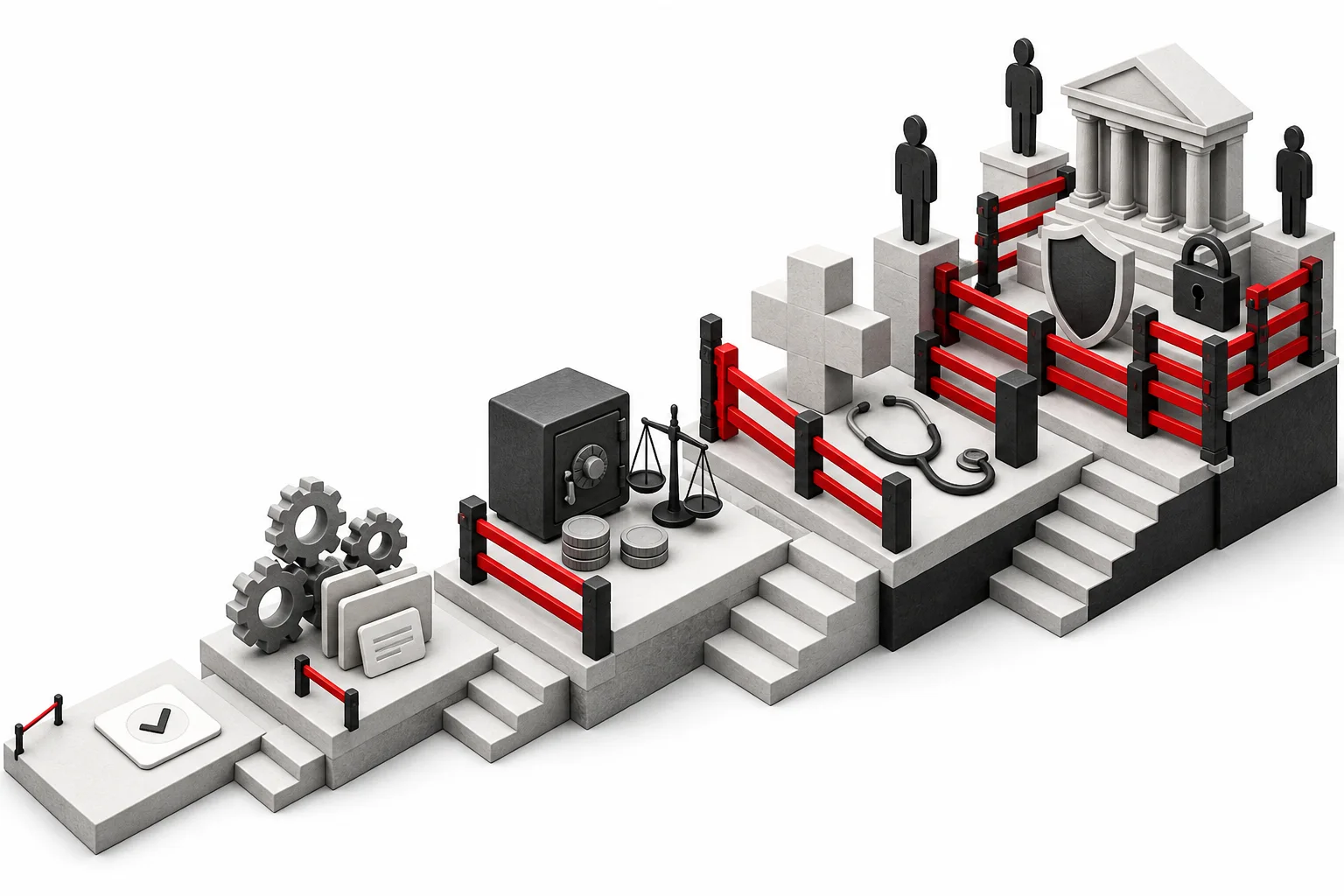
A wrong restaurant recommendation is annoying. A wrong medication instruction, financial transfer or compliance decision can be serious. The higher the consequence, the more the system needs validation, answers limited to a known set of options, fixed checks around the model, and human review.
Do not treat a model's confidence score as a magical safety meter unless you have checked what it actually means for your task.
Define the fallback before the demo
What happens when the model cannot answer, the provider is down, the output comes back in the wrong shape, or the search step finds only weak evidence?
A live feature needs a fallback: ask the user for clarification, return search results, route to a human, use the fixed-rules path, or fail safely.

Measure quality with your examples
Public benchmarks are useful for model research and a poor substitute for your own workflow. Build a small evaluation set — real inputs paired with the answers you would accept — before choosing a model or designing an agent.
If nobody can define what 'good' looks like for 50 representative cases, the feature is not ready to be called intelligent.
Price latency and cost into the experience
An AI step can add seconds and variable cost where a normal function adds milliseconds and almost none. That may be acceptable if the capability is valuable. It may be absurd if the model is formatting a date.
Use the simplest system that meets the user need.
The framework
Use AI when the input is messy and the output benefits from judgement or generation. You also need three things to be true: the damage from a wrong answer is limited, quality can be measured, and the fallback is acceptable. Use ordinary software when the rules are stable and the answer has to be exact.
The goal is not an AI product. It is a useful product that may contain AI where AI earns its place.