
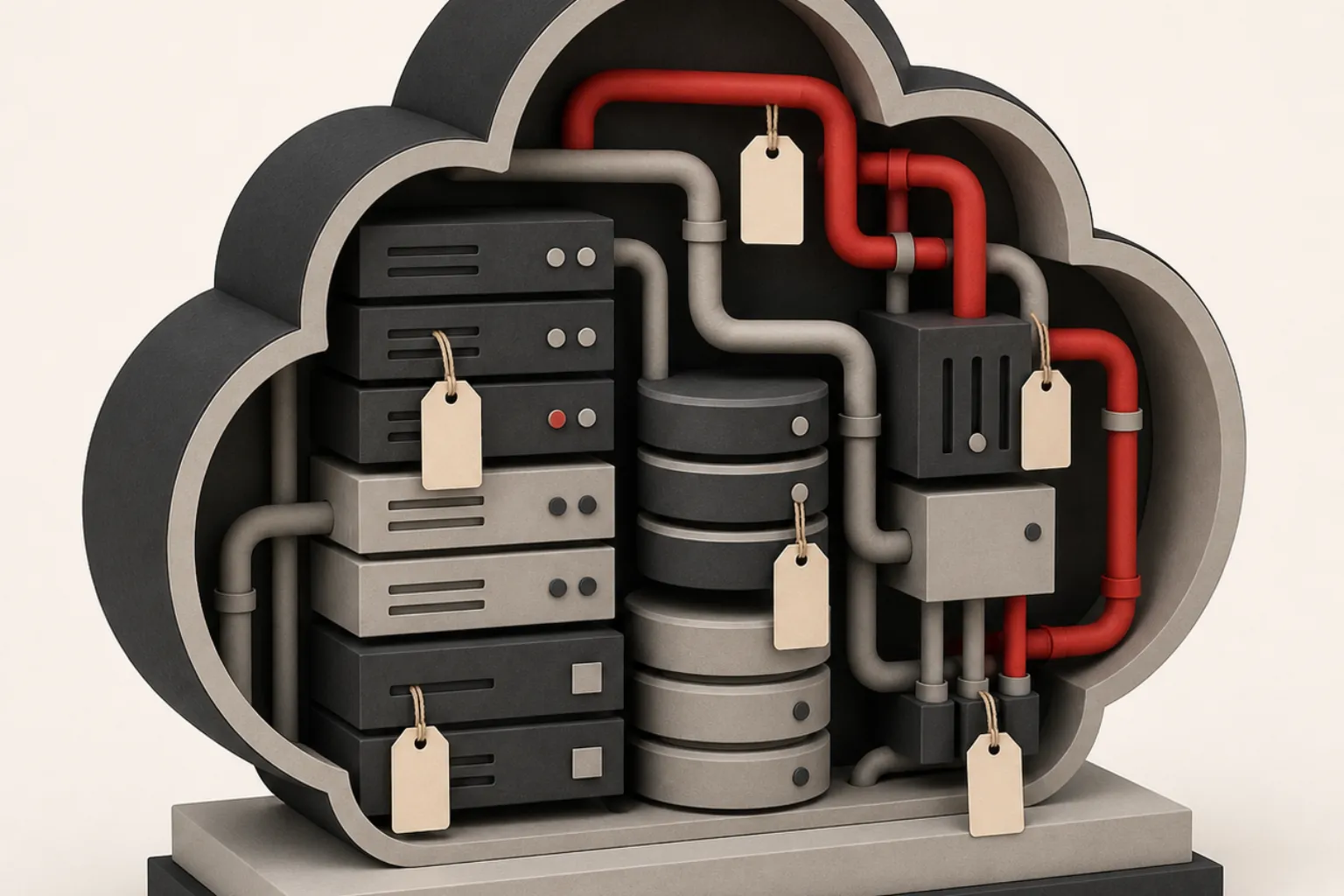

Cloud cost is not only a finance number. It is a map of architecture, traffic, forgotten environments, data movement and sometimes one loop that became much more enthusiastic than expected.
Cost is an observability signal with a currency symbol.
Start by making cost attributable
A single monthly total is difficult to act on, so split it up. Tag environments, products and major workloads. Separate production from staging, compute from databases, storage from data transfer, and the predictable baseline from cost that moves with usage.
The goal is not accounting perfection. It is enough detail to answer ‘what changed?’ when the bill moves.
Watch unit economics, not only totals
A cloud bill doubling because customers doubled may be healthy. A bill doubling while active users stayed flat is different.
Track a unit cost or two, wherever the product lets you measure one: infrastructure cost per active customer, per transaction, per document processed, per AI request or per GB served.

Idle resources tell process stories
Oversized databases, forgotten staging clusters, unattached volumes, old snapshots and always-on test environments are rarely just infrastructure mistakes. They usually point at something simpler: nobody owns the resource, and nothing shuts it down automatically.
If nobody knows whether a resource can be deleted, the real problem is not the $83. It is missing context.

Data transfer and logging can surprise you
Teams look at compute first. But chatty services, traffic crossing regions, large media delivery and high-volume logs can quietly add up to real money.
Cost reviews should follow data flow as well as CPU charts.
Do not optimise the bill before the product
An early-stage product should not spend two weeks eliminating $40 of monthly compute while a critical customer flow is broken. Optimisation has opportunity cost too.
Focus on waste, on the places where the design will break as you grow, and on costs that rise faster than usage. Leave small predictable costs alone until they matter.
Build cost alarms into operations
A sudden change in spend can mean a traffic spike, a runaway job, abusive usage, a configuration mistake or a cache that stopped working. Budget alerts and spend-anomaly detection are engineering tools, not only finance tools.
A 3 a.m. cost spike is sometimes the first symptom your system gives you.
Cost is part of architecture
Cloud cost should influence design alongside performance, reliability and developer experience. The cheapest architecture is not always the best one. The point is to know which costs buy real product value and which buy avoidable complexity.
A good bill is not necessarily small. It is explainable.