
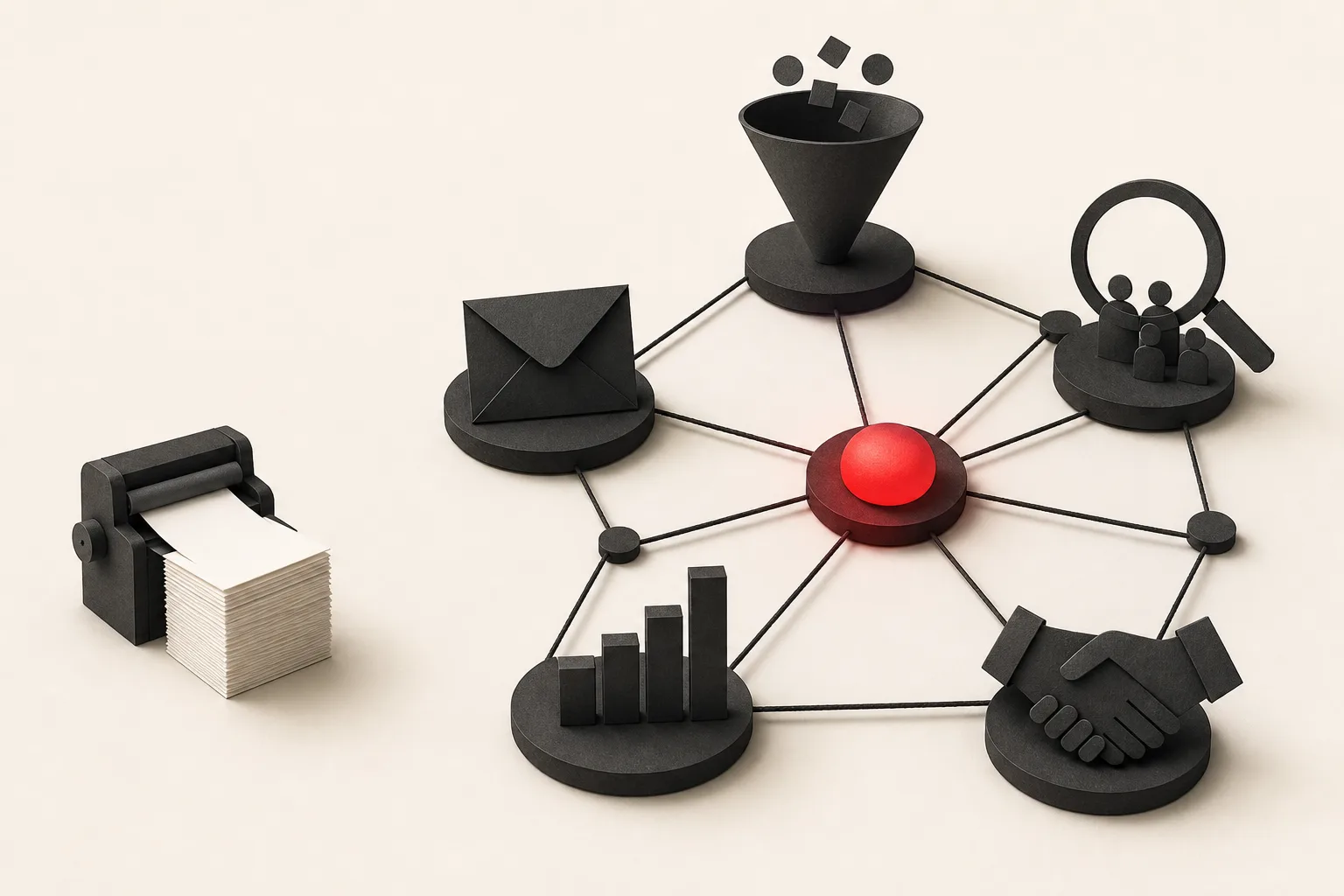

Ask ten companies how they use AI in marketing and nine will show you a prompt that writes LinkedIn posts. That’s useful. It is also roughly 5% of the opportunity.
Marketing has never really been about producing content. It has been about making decisions.
Marketing is a decision function
For the last few years, “AI in marketing” has mostly meant generating things faster: captions, blogs, ad copy, emails, images and social posts. The productivity gains are real. But there is a much bigger question hiding underneath: what happens when AI stops being a content generator and starts becoming the intelligence layer across the entire marketing function?
Every marketing team runs on the same chain of decisions. Who should we reach? What do they need? What should we tell them? When should we reach them, and on which channel? Are they actually interested? What should happen next — and what did we learn from the interaction?
Content is only one output of those decisions. The real opportunity for AI is to improve the decisions themselves.
Attract, understand, convert, learn
A useful way to think about AI marketing is not as a content-generation engine but as an interconnected system: attract → understand → convert → retain and learn. Each stage creates data and intelligence that improves the next.
Attract
The first job is getting the right people into your ecosystem, and AI can already influence far more than content production here: AI-powered search and SEO, search-intent analysis, paid advertising optimisation, audience discovery, social intelligence, competitive intelligence. Instead of asking AI to “write me a LinkedIn post about our product,” the better question becomes: “Which audience is showing increasing intent around this problem, what are they searching for, and where can we reach them?” The first creates content. The second creates marketing intelligence.
Understand
Attention is only the beginning. The next challenge is understanding what happens after people arrive: what they looked at, what they ignored, what problem they were researching, and whether they are exploring, comparing or ready to buy.
Imagine two visitors landing on the same website. Visitor A reads three educational articles and downloads a guide. Visitor B looks at pricing, case studies and implementation details. A traditional analytics dashboard shows you two website visitors. An intelligent system recognises they are at very different stages of intent — and that they should probably not receive the same message.

Convert
This is where marketing intelligence connects directly with revenue: lead enrichment, lead scoring, qualification, personalisation, offer and next-best-action recommendations, CRM automation, sales handoffs. When a lead enters the CRM, instead of simply assigning it to a salesperson, an AI system can work out who this is, what problem they are likely solving, how strong their intent is, what the sales team should know and what should happen next. Marketing stops operating as a content department sitting separately from sales and becomes an intelligence layer supporting the entire customer journey.
Retain and learn
Then comes the part most marketing stacks underuse: learning from what already happened. A campaign doesn’t end when the ad stops running, and a lead doesn’t stop being valuable when it enters the CRM. AI can help connect campaign → interaction → lead → sale → customer → outcome, which unlocks email automation, attribution, churn prediction, audience refinement and continuous optimisation. Instead of asking “Did our campaign get 100,000 impressions?” you start asking better questions: which audience responded, which message moved them, which channel produced qualified demand, which leads converted — and what should we change next time? That is where marketing becomes a learning system.
The full stack, layer by layer
The full stack goes much beyond generative content:
- Content intelligence. What content works, for whom, in which context and at what stage of the funnel — the right content for the right situation, not simply more content.
- Audience intelligence. Understanding audiences through behaviour, intent, interests and patterns instead of demographic buckets — what individual segments are actually trying to accomplish.
- Campaign intelligence. Connecting performance across channels to identify what drives meaningful outcomes. Not just clicks. Not just impressions. Business impact.
- Lead intelligence. A lead is more than a name, email and company. Combining signals to understand quality, intent and fit helps sales spend time on the opportunities that actually matter.
- Personalisation. The old model was one campaign → one audience → one message. AI makes it possible to move toward one audience → multiple contexts → relevant experiences, where message, offer, timing and channel adapt to signals.
- CRM automation. Marketing generates enormous amounts of information and much of it never gets acted upon. AI can automate repetitive workflows, update records, summarise interactions, trigger follow-ups and surface opportunities — the CRM becomes less of a database and more of an operational system.
- Analytics. Dashboards tell you what happened. AI can increasingly explain why it happened, what matters and what you should investigate next — because more data doesn’t automatically create better decisions. Better interpretation does.
- Marketing agents. Instead of one AI tool doing one task, organisations can build specialised agents: one monitors search demand, another analyses campaign performance, another qualifies leads, another recommends experiments, another prepares reports. And they can work together.
- Human approvals. AI can analyse, recommend and automate — but not every decision should be automated. Brand positioning, sensitive communications, major campaign decisions, pricing and strategic direction still require human judgement. The strongest systems won’t remove humans from the loop; they will put humans where human judgement creates the most value.
Where most companies get it wrong
The easiest way to spot immature AI adoption in marketing is to look at what the team measures. If the conversation is mostly about posts generated, blogs written or campaigns produced faster, AI is being used as a productivity tool rather than a decision-making system. When every company can generate competent content in seconds, content volume stops being a meaningful competitive advantage. The advantage moves to data, audience understanding, intent detection, experimentation and the systems connecting them.
Imagine publishing ten times more content, but reaching the wrong people, attracting weak leads or generating clicks without revenue. AI can accelerate every one of those problems. So the first question should not be “Where can we add AI?” It should be: “Where in the marketing decision chain are we losing information, time or accuracy?”
Strong AI marketing implementations begin with a business decision. Which leads should sales contact first? Which customers are most likely to buy again? Which search topics indicate emerging demand? Which campaign deserves more budget? Only after defining the decision should the organisation decide where AI belongs. Sometimes the answer is a generative model. Sometimes it is classification, predictive analytics, or an agent connected to a CRM. Sometimes the best answer is not AI at all. Good AI strategy is not about maximising AI features. It is about maximising business value.
Data is the hidden layer
AI marketing initiatives often disappoint because the model gets attention while the underlying data gets ignored. An intelligent marketing system is only as useful as the information flowing through it. Website behaviour, campaign interactions, CRM records, customer conversations, search behaviour and purchase history all tell different parts of the same story. When those signals remain trapped in separate systems, the organisation sees fragments. When they are connected, it starts seeing customer journeys. That is the difference between having marketing data and having marketing intelligence.
Context is where the value shows up. Compare a generic AI-generated email — “We noticed you may be interested in our services” — with a system that knows the customer recently explored a specific solution page, returned twice, downloaded a related resource and belongs to an account currently expanding in that category. The second system can recommend a far more relevant next action. The difference is not better writing. It is better context.
From campaigns to learning systems
Most companies are currently assembling AI tools: one writes content, another analyses keywords, another creates images, another scores leads, another automates emails. But adding AI tools isn’t the same as building an AI marketing system. The real opportunity lies in connecting these capabilities into one loop: data → intelligence → decision → action → outcome → learning.
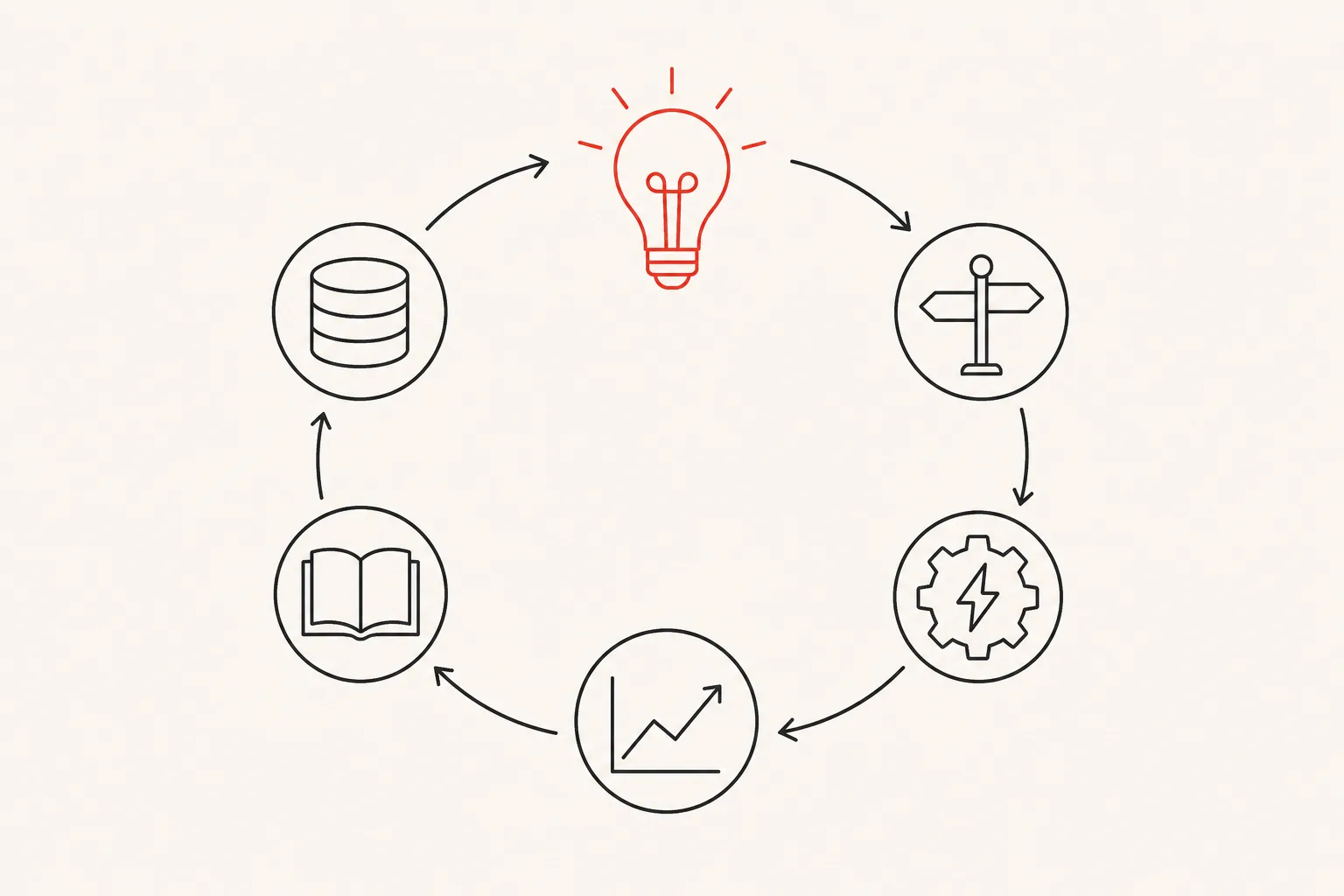
Picture that loop running. The system detects a change in search behaviour and identifies an emerging customer problem. It analyses which audience is showing the strongest intent and recommends a campaign. Content is created for that audience, qualified leads are identified, the CRM automatically routes them, sales receives the relevant context, customer behaviour is monitored — and the results feed back into the system, so the next campaign gets smarter. That is not an AI copywriter. That is an AI-powered marketing operating system.
It also changes marketing’s relationship with time. Traditional marketing works in cycles: plan, launch, measure, report, repeat. AI creates something more continuous — signals monitored constantly, audiences refined continuously, lead scores changing as new information arrives, customer journeys adapting to behaviour. The marketing function starts behaving less like a sequence of campaigns and more like a learning system. And it does not necessarily mean smaller marketing teams; it means different ones. Less time pulling reports, moving data and qualifying leads from scratch. More time on positioning, experimentation, customer understanding and strategic decisions. Machines handle scale. Humans handle judgement.
What Script Lanes is building toward
This is the direction we believe AI marketing is heading. Not another tool that promises to generate your next 30 social posts. Not another chatbot sitting on a website. Not AI for the sake of putting “AI” in front of an existing workflow. We see AI as an intelligence layer that connects the fragmented parts of marketing — audience, content, campaigns, leads, CRM, sales, customer behaviour, analytics — into systems that don’t just execute marketing tasks, but help businesses understand, decide, act and learn.
The next generation of marketing won’t be won by the company producing the most content. It will be won by the company that understands its customers faster, makes better decisions and learns from every interaction.
The real definition of AI marketing
So perhaps we need to stop defining AI marketing as “marketing + generative AI.”
AI marketing is the use of intelligent systems to continuously improve who a business reaches, what it communicates, when it communicates, how it converts and what it learns from every interaction.
Every company experimenting with AI marketing eventually reaches the same crossroads: do we use AI to produce more, or to understand more and decide better? The first option can improve productivity. The second can change the economics of the entire marketing function. The future of AI marketing is not a machine that writes your next post. It is a system that helps your business know who to talk to, what to say, when to say it, what to do next — and why. That is the full stack. And that is where the real opportunity begins.