


Creating ads used to have a simple bottleneck: production. Every new headline, image, hook, CTA or format meant more work for designers, copywriters and marketers. AI is changing that equation.
The new bottleneck is no longer “Can we create enough ads?” It is “Can we figure out which ads are actually worth running?”
The old constraint was production
Google Ads already offers generative AI tools for creating headlines, descriptions, images and multiple asset formats, while its systems can generate and test additional variations based on campaign context. Imagine a campaign team wants to test 10 headlines. Traditionally, that means writing, reviewing, designing, formatting and approving each variation. Now AI can generate dozens of options in minutes — and the same applies to visuals, hooks, CTAs and formats.
A team could generate 10 headlines, 20 images, 5 hooks, 3 CTAs and 4 formats. That creates 10 × 20 × 5 × 3 × 4 = 12,000 possible combinations. And that is from a relatively small creative library.
More creative does not automatically mean better creative
This is where brands can get into trouble. If AI makes 100 variations, the answer is not to publish all 100. More creative can quickly become more noise, more fragmented learning and more opportunities for off-brand messaging. The real system needs to answer five questions:
- What are we testing?
- Who are we testing it with?
- What result defines a winner?
- What should happen to weak variations?
- Which learnings should influence the next batch?
AI should create the possibilities. The marketing system should decide which possibilities deserve attention.
Think in creative hypotheses, not random variations
Instead of asking AI to “make 50 ads,” give it a hypothesis. Suppose a SaaS company is advertising an AI customer-support platform. It could test three different ideas: speed (“Resolve customer questions in seconds, not hours”), cost (“Handle more support without growing your support team”) and quality (“Give every customer a consistent answer, 24/7”). AI can generate multiple headlines, visuals, hooks and CTAs around each idea. The team is not just producing more ads. It is running structured experiments.
Brand guardrails become critical
When creative production was slow, human review naturally acted as a quality filter. When AI can generate hundreds of assets, that filter becomes more important. Your guardrails can define:
- Brand colours, fonts and visual style
- Approved messaging and claims
- Words, phrases and promises to avoid
- Tone of voice
- Logo and product usage rules
- Audience-specific restrictions
- Legal and regulatory requirements
Google itself recommends using accurate, recent brand and landing-page inputs to keep generated creative aligned with the business.
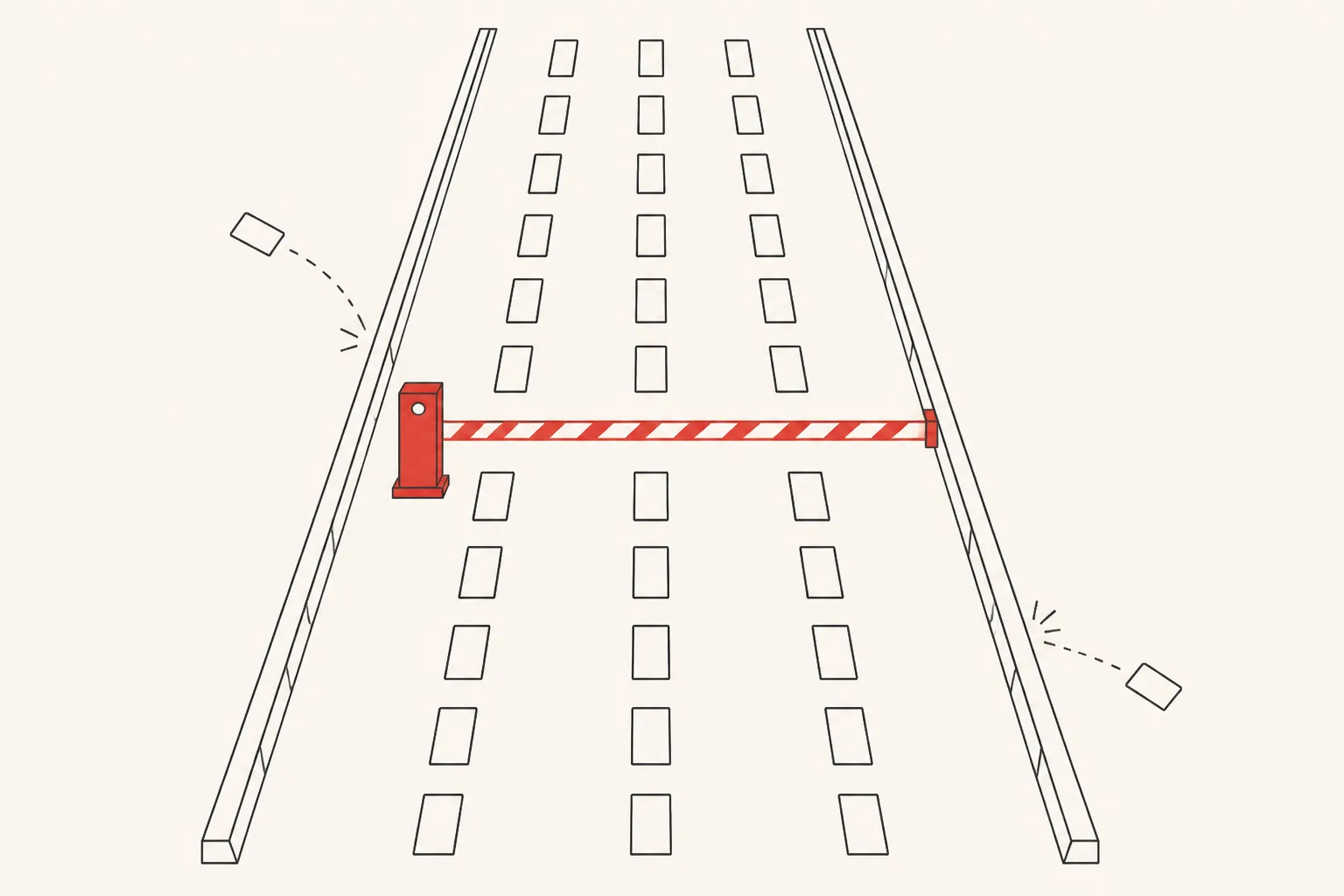
The creative loop should look like this
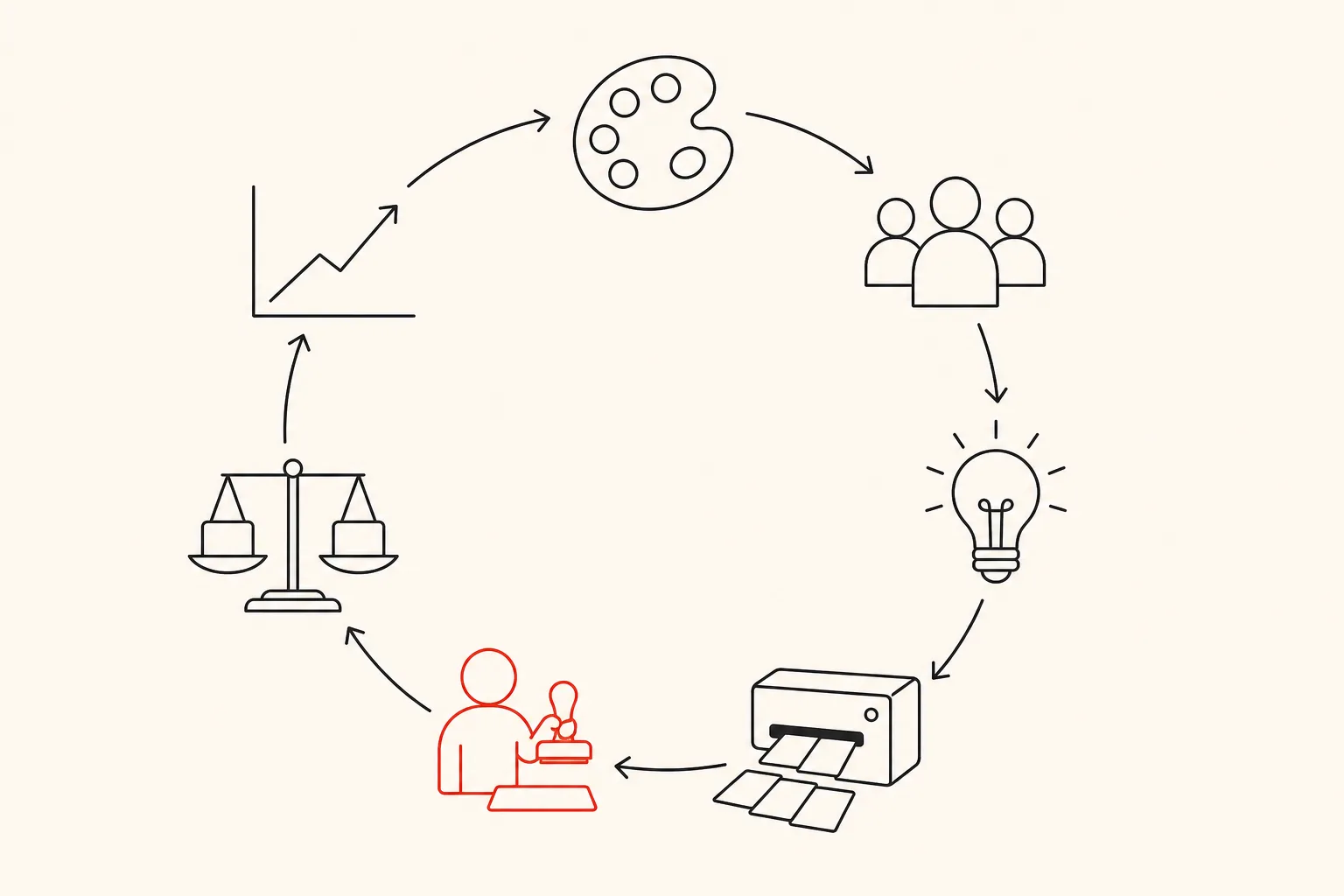
The strongest model is not generate → publish. It is a feedback loop: brand inputs → audience segment → creative hypothesis → AI generation → human approval → test → conversion data → winner/loser analysis → next generation.
Suppose you launch 40 variations. After enough impressions and conversions, the system might discover that hook A gets 1.8× higher CTR than hook B; image 7 generates 32% more landing-page visits than the average; the CTA “Book a demo” produces more conversions than “Learn more”; and the cost-per-qualified-lead is lowest among healthcare decision-makers exposed to the speed-focused message. The next batch should not start from zero. It should build on those learnings.
Winners are measured in outcomes, not CTR
Imagine a campaign starts with 100 AI-generated variations. After testing, only 20 receive enough engagement to move forward. Of those 20, 8 generate strong click-through rates. But only 5 produce qualified leads at an acceptable cost. Eventually, 3 consistently outperform the rest. The objective was never to find the ad with the highest CTR. It was to find the creative that produces the business outcome that matters. An ad with a 6% CTR but poor conversion quality may be less valuable than an ad with a 3.5% CTR that generates customers.
“How many ads did AI make?” is an impressive productivity metric, but it is not a business metric. Track outcomes such as:
- CTR for initial engagement
- Landing-page conversion rate for post-click quality
- Cost per qualified lead for sales efficiency
- Conversion rate for business impact
- ROAS or revenue per impression for commercial performance
- Creative fatigue to know when winners are losing effectiveness
AI can make production nearly limitless. Your measurement system has to make decision-making more disciplined.
Audiences and formats multiply the challenge
The same product can require very different messaging for different audiences. A CFO may respond to “Reduce operational cost without adding headcount.” A CTO may care more about “Deploy with your existing infrastructure and APIs.” A founder may respond to “Scale support without scaling the team.” AI makes it easier to create variations for each segment without manually producing every version — but the underlying brand promise should remain consistent.
Creative is also no longer one static banner. The same campaign might need 1:1 social creative, 4:5 feed creative, 9:16 Stories and Reels, 16:9 video or display, short video, long video, static images and carousels. Google’s current AI creative tools can generate or adapt assets across formats, including additional video orientations and image variations. The creative system needs to preserve the same core message while adapting the execution to the placement.
Human approval still matters
Generative AI can produce something visually impressive and still produce something inaccurate, misleading or off-brand. Google explicitly advises advertisers to review generated assets for accuracy, policy compliance and misleading content before publishing. That is why the best workflow is not AI replacing the creative director. It is AI giving the creative director leverage. Instead of spending the morning making 12 banners, the creative director can spend that time deciding which creative direction deserves 100 variations.
There is also a new compliance layer. As AI-generated advertising becomes normal, transparency is becoming part of the workflow: Google announced in July 2026 that AI-generated or AI-edited ad assets can carry AI labels, with additional disclosure requirements relevant to markets including India. So a scalable AI creative system needs more than prompts and templates. It needs approval, policy checks and appropriate disclosure processes.
The new creative bottleneck
The old advertising problem was: “We need more creative, but we don’t have enough time or people to make it.” The new problem is: “We have more creative than we can intelligently evaluate.” That is a much better problem to have, but it still needs a system. The winning brands will not necessarily be the ones generating the most ads. They will be the ones that can move fastest from idea → variation → test → learning → winner → scale without losing their identity along the way.
And somewhere in that process, your creative director is still staring at 847 AI-generated ads. AI: “I made 847 more.” Creative director: “Please stop helping.” The joke is funny because the underlying problem is real. AI has made creative production cheap. The competitive advantage now comes from knowing what to create, what to test, what to kill and what to scale.